
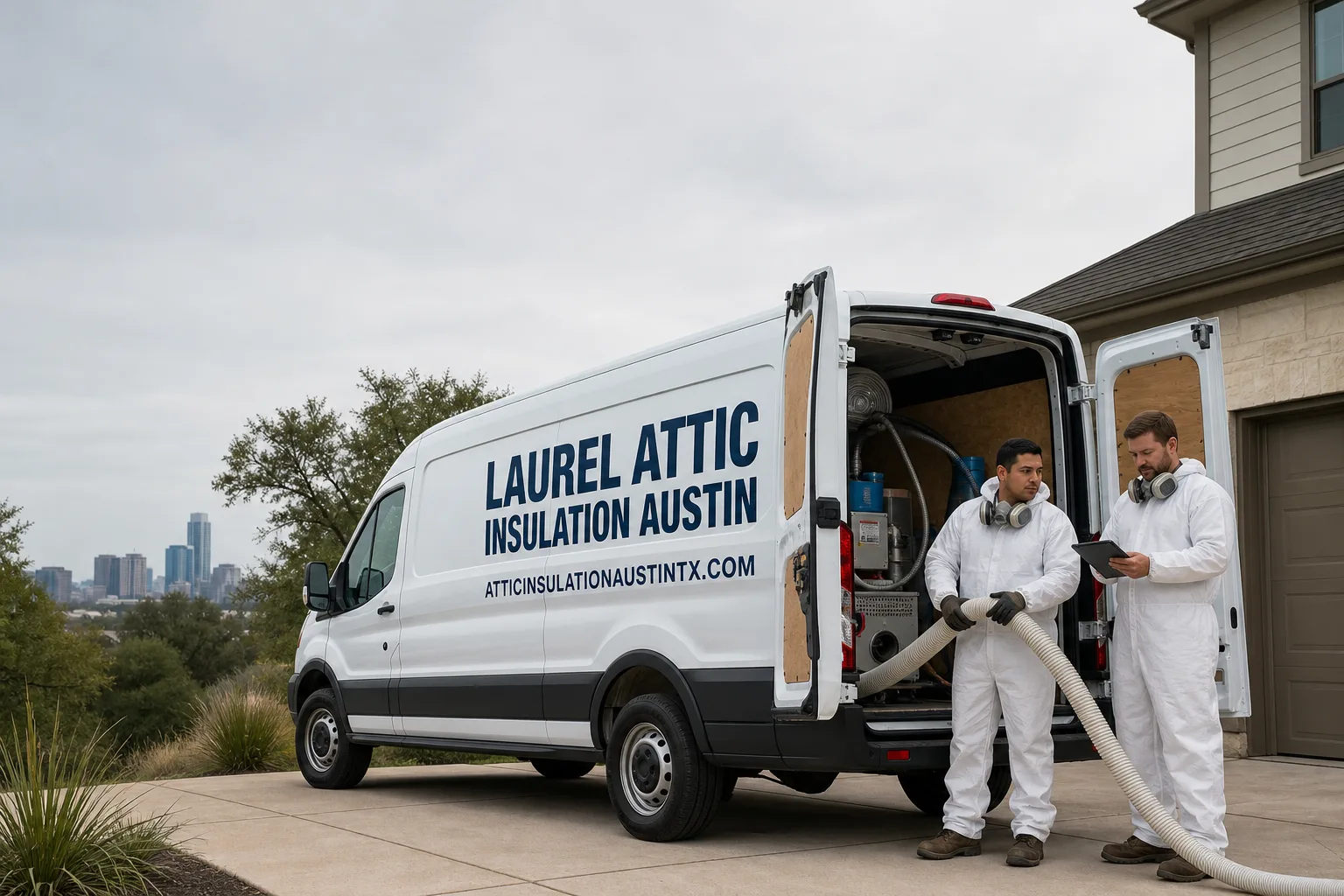
How Much Does Blown-In Insulation Cost in Austin?
Blown-in insulation in Austin typically costs $1,450 to $3,800 for a standard 1,500-square-foot attic, with most homeowners in neighborhoods like Allandale, Mueller, and Circle C paying between $1.15 and $2.85 per square foot installed. The price depends largely on the material you choose (fiberglass, cellulose, or mineral wool), the R-value you’re targeting, and how much old insulation needs to come out first. In Austin’s climate, where attic temperatures regularly climb past 140°F in July and August, a properly insulated attic isn’t a luxury upgrade; it’s the difference between an electric bill you shrug at and one you dread opening.
Blown-In Insulation Cost Breakdown (2026)
Here’s what we’re seeing across Austin in 2026 for blown-in insulation work, based on square footage and material type. These are installed prices that include labor, equipment, and cleanup.
| Project Scope | Fiberglass | Cellulose | Mineral Wool |
|---|---|---|---|
| Small attic (600-800 sq ft) | $950 – $1,600 | $1,100 – $1,850 | $1,500 – $2,400 |
| Standard attic (1,200-1,500 sq ft) | $1,450 – $2,400 | $1,700 – $2,800 | $2,300 – $3,800 |
| Large attic (2,000+ sq ft) | $2,300 – $3,600 | $2,700 – $4,100 | $3,500 – $5,200 |
| Top-up over existing insulation | $850 – $1,500 | $950 – $1,700 | $1,300 – $2,100 |
| Full removal + new blown-in | $2,100 – $3,400 | $2,400 – $3,900 | $3,100 – $4,800 |
Those ranges reflect the Austin market specifically. Labor rates here are higher than in Waco or Killeen, partly because of the city’s construction boom and partly because working in a 140°F attic in August demands a certain rate. If a quote comes in dramatically below these numbers, ask what’s being left out – usually it’s the removal of old insulation, air sealing, or cleanup.
What’s Included in a Blown-In Insulation Quote
Every Austin insulation contractor prices differently, but a complete quote should always include these line items. If a company hands you a one-line number with no breakdown, that’s a red flag. At Laurel Attic Insulation Austin, we put the full written price in your hand before any work starts. That price covers:
- Material cost – measured in bags. A 1,500-square-foot attic at R-38 needs roughly 25 to 30 bags of cellulose or 35 to 40 bags of fiberglass.
- Labor – typically two technicians for four to six hours on a standard attic. Blowing machines, hoses, and ventilation gear add to hourly overhead.
- Prep work – covering soffit vents with baffles, marking depth gauges, and protecting attic access points.
- Air sealing – caulking and foaming around recessed lights, plumbing penetrations, and top plates. We include this on every job; many Austin contractors charge extra for it or skip it entirely.
- Cleanup – vacuuming the attic access, hauling empty bags, and leaving your hallway cleaner than we found it.
What Affects Blown-In Insulation Pricing in Austin
Austin isn’t one pricing market. A 1930s bungalow in Travis Heights prices differently than a brand-new build in Easton Park. Here are the factors that actually move the number.
- R-value target. R-value measures how well insulation resists heat flow. Austin’s climate zone (Zone 2A) means building code calls for R-30 to R-38 in attics. Many older Austin homes sit at R-11 or R-19. Bumping from R-19 to R-38 can add $500 to $900 depending on attic size. Going to R-49, which some homeowners do for maximum summer comfort, adds another $300 to $600.
- Old insulation removal. If you’ve got rodent damage, decades of dust, or water stains from a roof leak, that material needs to come out before new insulation goes in. Removal alone runs $1.50 to $2.50 per square foot, and in homes near the Greenbelt, we routinely pull out insulation that’s been shredded by squirrels nesting for years.
- Attic accessibility. Attics with low clearance, awkward truss work, or tight access hatches slow the crew down. Homes in older Austin neighborhoods like Hyde Park and Rosedale often have steep roof pitches and cramped attic spaces, which adds labor hours.
- Air sealing complexity. Recessed lighting cans, bathroom exhaust fans, and old knob-and-tube wiring penetration points all need sealing. In older Austin homes, it’s common to find 30 or 40 penetration points. In a newer build, maybe eight. That difference can be $200 to $400 on its own.
- Material choice. Cellulose is typically the most cost-effective option in Austin and performs well in our heat because of its density. Fiberglass is cleaner and easier to work with but costs slightly more per R-value delivered. Mineral wool is premium – it’s naturally fire-resistant and holds its R-value in humidity, but it’s the most expensive of the three.
- Seasonal demand. Austin insulation pricing cycles. Demand spikes in May and June when the first 100°F days hit, and you’ll sometimes pay a premium for a two-week scheduling window. Rates in December and January are easier, but attics are more comfortable to work in during the winter, which means crews move faster and the labor component drops slightly.
Blown-In Insulation Materials: What Austin Homeowners Choose
You’ll hear three material names thrown around when you start calling insulation companies in Austin. Each has a real cost profile and a real performance difference in our climate.
Fiberglass Blown-In: $1.15 to $2.10 per sq ft installed
Fiberglass is the most common material used in Austin attics. It’s made from spun glass fibers and comes in compressed bags that get fed through a blowing machine. It doesn’t settle as noticeably as cellulose and doesn’t hold moisture, which matters in a city where humidity lingers from May through October. We install Owens Corning and Johns Manville fiberglass most often. The downside: fiberglass loses some effective R-value at attic temperatures above 130°F – and Austin attics hit that for weeks straight in summer.
Cellulose Blown-In: $1.30 to $2.35 per sq ft installed
Cellulose is ground-up recycled paper treated with borate for fire resistance and pest deterrence. It’s denser than fiberglass, which means it performs better against radiant heat – the exact kind of heat beating down on your roof from June to September. Dense-packed cellulose in an Austin attic holds its R-value better in extreme heat. We use GreenFiber cellulose for most cellulose jobs. One thing to know: cellulose can settle 5 to 10 percent over the first few years, so a good installer compensates by over-blowing slightly.
Mineral Wool Blown-In: $1.90 to $3.15 per sq ft installed
Mineral wool, also called rock wool, is spun from volcanic rock and recycled slag. It’s naturally fire-resistant up to 2,000°F, doesn’t absorb water, and won’t grow mold even if a roof leak goes undiscovered for months. In Austin, it’s the right choice for homeowners near wildfire-prone areas like the western stretches of 78730 and 78746, or for anyone who wants the best possible sound deadening. It costs more. It also lasts as long as your house.
How Much Does It Cost to Remove Old Insulation in Austin?
If your existing insulation is water-damaged, rodent-infested, or compressed to the point where it’s doing nothing, removal comes first. Expect to pay $1.50 to $2.75 per square foot for full removal in the Austin market. That covers extracting the old material with a commercial vacuum, bagging it, cleaning the attic floor, and preparing the space for fresh insulation. In a 1,200-square-foot attic, that’s roughly $1,800 to $3,300 for removal alone – then the re-insulation cost on top. Some Austin companies bundle removal and re-insulation at a reduced blended rate. At Laurel Attic Insulation Austin, we quote removal and new insulation as separate line items so you see exactly what you’re paying for.
How to Save on Blown-In Insulation in Austin
Insulation isn’t where you want to pinch pennies and end up doing the job twice. That said, there are legitimate ways to keep your Austin insulation project affordable without cutting corners.
- Ask about a top-up instead of full replacement. If your current insulation is dry, pest-free, and just under-performing, blowing additional material over the top is often sufficient. You’ll pay roughly half what a full removal and replacement costs. A quick attic inspection tells you which path makes sense.
- Schedule in the off-peak months. December through February is the slow season for Austin insulation companies. Crews are less rushed, scheduling is flexible, and you avoid the spring rush that starts in March.
- Check for Austin Energy rebates. The City of Austin has offered weatherization and home performance rebates through Austin Energy in recent years. Programs change, but it’s worth a phone call or a quick search before you write the check. We can point you in the right direction during your estimate.
- Bundle air sealing with insulation. Many Austin contractors charge a separate trip fee for air sealing if it’s ordered alone. Have it done in the same visit as your insulation install and you’ll typically save $150 to $300 on the combined scope.
- Get a written estimate, not a verbal ballpark. A written price locks your cost in. It also forces the contractor to be specific about what’s included. At Laurel Attic Insulation Austin, the written price we hand you before any work begins is the price you pay – no recalculation at the door. Call (361) 321-0817 for a free estimate with real numbers specific to your attic.
Why Blown-In Insulation Costs What It Does in Austin
Austin’s cost of living and construction labor market have shifted dramatically in the last decade. Insulation installers here earn more than their counterparts in San Antonio or Fort Worth because the cost of living demands it. Beyond labor, material costs have followed national trends: fiberglass and cellulose prices rose through 2024 and 2025 and have stabilized in 2026 at roughly 12 to 18 percent above pre-2022 levels. A third factor is simply the Austin construction boom. So many homes are being built and remodeled that insulation crews are in constant demand, and that demand keeps pricing firm.
The good news: insulation remains one of the few home improvements that pays you back. The Department of Energy estimates that proper attic insulation and air sealing can cut heating and cooling costs by 15 percent. In Austin, where summer cooling is the dominant energy expense, that’s not a small number. Over a Texas summer, a well-insulated attic can save $300 to $600 in AC costs depending on your home’s size and your thermostat habits.
What to Expect When You Book Blown-In Insulation in Austin
If you’ve never hired an insulation contractor, here’s how a typical Austin project goes, from first call to final walkthrough.
- Phone call and scheduling. You call, talk to a real person, and schedule a site visit. At Laurel Attic Insulation Austin, we answer the phone 24/7 – you won’t get a voicemail or a callback queue.
- Attic inspection. A technician measures your attic’s square footage, checks current insulation depth, looks for air leaks, identifies pest damage, and assesses accessibility. This takes 30 to 45 minutes.
- Written quote. You get a written price with material type, R-value target, square footage, and line-by-line costs. The Relay Visibility Guarantee means this written price arrives before any work is scheduled.
- Installation day. Your crew arrives at a live, trackable time – not a four-hour window. They’ll set up the blowing machine outside, run a hose through the attic access, and work through the space methodically. Plan for two to four hours on-site for most attics.
- Photos and walkthrough. You receive before-and-after photos of the attic. You should see depth markers, even coverage, and a clean workspace. Pay from the invoice link on your phone.
- Follow-up. If anything’s not right during the first 365 days, the Done Right Promise covers it. We come back and make it right, in writing, no argument.
Blown-In Insulation vs. Spray Foam: Austin Price Comparison
You’ll hear about spray foam when you research insulation in Austin. It’s a different product with a different price point. Open-cell spray foam in an Austin attic runs $2.50 to $4.50 per square foot installed, and closed-cell runs $4.00 to $7.00 per square foot. Compared to blown-in at $1.15 to $2.85 per square foot, spray foam is two to three times the cost. It does offer a higher R-value per inch and acts as an air barrier, which is why some Austin homeowners choose it for cathedral ceilings or awkward spaces. But for a standard vented attic, blown-in insulation remains the smartest dollar-for-dollar choice for most homes. We install both, and we’ll tell you straight which one earns its cost in your specific attic.
How R-Value Translates to Comfort in Austin
R-value is the number that measures how well insulation slows heat from moving through your ceiling. The higher the number, the more resistance. Most Austin homes built before 2000 have R-11 to R-19 in the attic. Current code recommends R-30 to R-38. Here’s what that gap means in practical terms: on a 100°F day, an R-11 attic lets a lot more heat transfer into your living space than an R-38 attic. Your AC works harder, runs longer, and your upstairs rooms never quite cool down. Getting from R-11 to R-38 in a 1,500-square-foot Austin attic costs roughly $1,200 to $2,200 with blown-in insulation. The comfort difference is immediate, and the electric bill difference shows up on your next statement.
Laurel Attic Insulation Austin: What Our Bid Includes
Laurel Attic Insulation is the insulation specialist within the Relay Home Co. family of home-service businesses. We’ve been doing this since 2003, and we’re independently owned and operated right here in the Austin market. Our crews arrive in uniform, background-checked, with a live tracking link so you know exactly when we’ll pull up. We install materials from eight trusted manufacturers – Owens Corning, Johns Manville, Knauf, Rockwool, CertainTeed, Icynene, Demilec, and GreenFiber – and we match the material to the job, not to whatever bag happens to be on the truck.
Every blown-in insulation job we do includes the Relay Visibility Guarantee: a written price before work begins, live technician tracking, and photo proof of the finished attic. It includes the 365-Day Done Right Promise – if it’s not right, we make it right, backed in writing. And it includes a free second visit if anything fails. That’s not a marketing line. It’s on every invoice.
Chase Whitaker leads our Austin insulation team, and every crew we send operates on one principle: show up when promised, price what’s quoted, and leave the attic better than we found it. Laurel stays green all year – so should your home’s comfort. That’s the idea behind the name.
If you’re still comparing numbers, the best move is a free estimate with a real attic measurement. No guessing, no “it depends” without numbers. Call (361) 321-0817 and we’ll schedule a visit, measure your attic, and put a written price in your hand.
FAQs – Blown-In Insulation Cost in Austin
How much does blown-in insulation cost per square foot in Austin?
Blown-in insulation in Austin runs $1.15 to $2.85 per square foot installed depending on material and R-value target. Fiberglass sits at the low end, cellulose in the middle, and mineral wool at the top. A 1,500-square-foot attic typically lands between $1,450 and $3,800 total. Call (361) 321-0817 for a free estimate on your specific square footage.
Is it cheaper to repair or replace attic insulation in Austin?
If more than 30 percent of your attic insulation is water-damaged, rodent-soiled, or compressed, replacement is cheaper in the long run. A top-up over decent existing insulation runs $850 to $1,700, while full removal and replacement runs $2,100 to $4,800. Patching bad spots repeatedly costs more over time. We’ll tell you honestly which route your attic needs.
How much does it cost to remove old blown-in insulation?
Insulation removal in Austin costs $1.50 to $2.75 per square foot. For a 1,200-square-foot attic, expect $1,800 to $3,300 for complete removal with a commercial vacuum, bagging, and attic cleanup. New insulation is a separate line item. Laurel Attic Insulation Austin quotes both separately so there’s no confusion.
Can blown-in insulation be installed in one day?
Yes. A standard 1,200 to 1,500-square-foot Austin attic takes two technicians about four to six hours. That includes setup, air sealing, blowing, and cleanup. Removal plus new insulation can stretch to a second day depending on attic condition. We’ll give you a clear timeline with your written estimate – call (361) 321-0817.
What R-value do I need in an Austin attic?
Austin’s climate zone recommends R-30 to R-38 in the attic. Most older Austin homes sit at R-11 to R-19. The upgrade from R-19 to R-38 costs roughly $900 to $1,800 for a standard attic and makes an immediate difference in summer cooling costs. Some homeowners go to R-49 for maximum heat resistance, adding $300 to $600 to the project.
Ready to get real numbers for your attic? Laurel Attic Insulation Austin offers free, written estimates with no pressure and no guessing. Call (361) 321-0817 today. Our team is available 24/7, and someone will always pick up.
Pricing reflects the Austin market as of 2026. Laurel Attic Insulation Austin offers free estimates – call (361) 321-0817.
Written by Chase Whitaker, Owner at Laurel Attic Insulation Austin, serving Austin, TX.
What Our Customers Say
"Spray foam in the crawl space. Floors feel warmer."
- Joanna S."Solid install. A little mess in the hall that was cleaned up when I mentioned it."
- Amelia T."Quote in the app was clear on R-value and price."
- Doris L.