
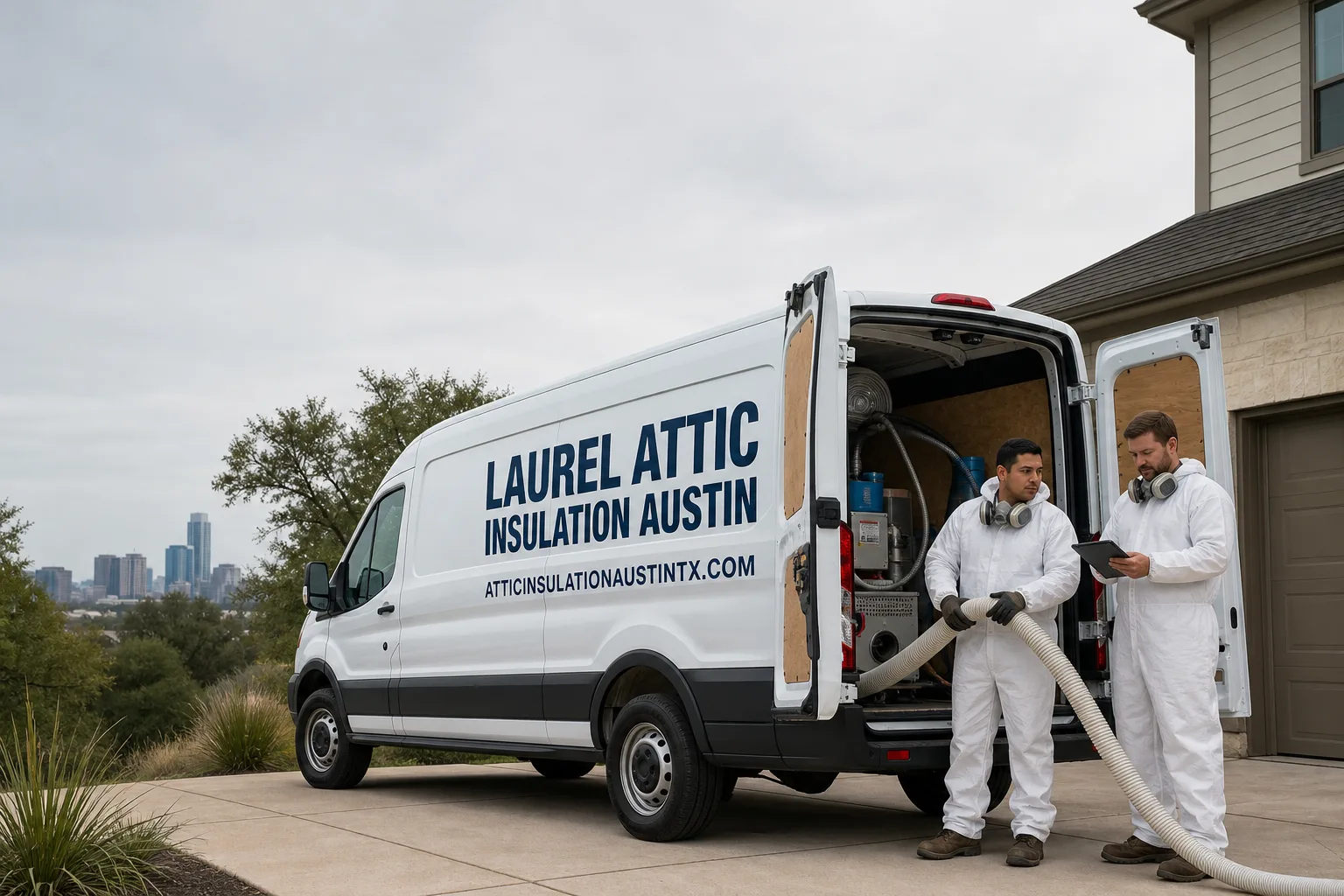
Trusted Spray Foam Insulation for Austin Homeowners
If you’re wondering how much Spray Foam Insulation costs, Austin prices typically run $1,800 to $4,800 for a full attic application, with smaller rim joist or crawl space projects at $600 to $1,500. It’s the only insulation that expands to seal air leaks and insulate in a single pass, which is a big deal in a climate where summer attic temperatures regularly hit 140°F. Laurel Attic Insulation Austin installs open-cell and closed-cell foam from Demilec, Owens Corning, and Icynene, every job backed by our 365-Day Done Right Promise and the Relay Visibility Guarantee. That means a written price before work starts, live technician tracking, and photo proof when the job is done. Call (361) 321-0817 for a free estimate, same-day appointments available in most Austin neighborhoods.
Closed Cell Spray Foam Insulation
Closed Cell Spray Foam Insulation is the denser of the two foam types, expanding to roughly 2 inches of rigid, waterproof insulation that adds structural strength to whatever it’s sprayed on. It acts as its own vapor barrier and stops air movement almost completely, which is why we recommend our Spray Foam Insulation in Austin for homes dealing with humidity from crawl spaces, flood-prone areas near Shoal Creek or Onion Creek, and metal buildings where condensation drips onto equipment. Laurel Attic Insulation Austin installs closed-cell foam from Demilec and Icynene, typically running $2.50 to $4.50 per board foot depending on depth and surface prep. Most closed-cell attic jobs in Austin land between $2,800 and $5,500.
Where Closed Cell Earns Its Cost
Closed-cell foam isn’t cheap, and we won’t pretend it is. But if you have a crawl space that stays damp, a rim joist that leaks air into a finished basement, or a garage wall shared with living space, closed cell solves problems open cell can’t touch. It also won’t absorb water, so a small leak won’t turn into a mold problem inside your insulation.
Strength and Air Sealing Combined
Because closed-cell foam hardens into a rigid shell, it reinforces wall cavities and roof decks. That’s a real benefit in Austin’s older bungalow neighborhoods like Hyde Park and Bouldin Creek, where framing has settled and every gap leaks conditioned air. One application handles insulation, air sealing, and moisture control at once.
Open Cell Spray Foam
Open Cell Spray Foam is the lighter, softer foam that expands dramatically to fill every crack and crevice in an attic, wall cavity, or ceiling. It’s breathable, meaning it doesn’t create a vapor barrier, but it excels at stopping air movement and deadening sound, which is why Austin homeowners in neighborhoods like Allandale and Crestview choose it for attic rooflines and shared walls. Laurel Attic Insulation Austin applies open-cell foam from Icynene and Demilec at roughly $1.20 to $2.75 per board foot. A typical open-cell attic application in Austin runs $1,800 to $4,200.
Best Fit for Attic Rooflines
If you’re converting an unconditioned attic into a semi-conditioned space or just want to stop the heat bleeding through your ceiling, open-cell foam sprayed directly on the roofline works exceptionally well. It fills the odd angles, gable ends, and soffit areas that batts and blown-in fiberglass leave exposed. The air sealing alone often cuts air leakage by half or more in older Austin homes.
Sound Control for Busy Households
Open-cell foam absorbs sound in a way rigid foam and fiberglass can’t match. Homeowners near MoPac, I-35, or the airport consistently tell us the difference is immediate after an application in bedroom walls or living room ceilings. If road noise or a home theater is part of your daily reality, open cell solves it without changing your home’s look.
Spray Foam Insulation Contractors
Spray Foam Insulation Contractors are the specialists who mix and apply the two-component foam on site, and the quality of the installation matters as much as the material. A bad foam job won’t bond, will off-gas for weeks, or will leave gaps that defeat the entire purpose. Laurel Attic Insulation Austin has been installing foam in the Austin market since 2003, with background-checked, uniformed technicians who show up at a live, trackable time and walk you through the scope before spraying. Project costs vary by square footage and foam type, but most Austin jobs fall between $1,200 and $5,000. Call (361) 321-0817 and we’ll give you a written price before anything is scheduled.
Who You’re Actually Hiring
Chase Whitaker leads our Austin insulation team, and every tech who shows up at your door works under the Relay Visibility Guarantee. That means you see who’s coming, when they’ll arrive, and what the job costs before the first hose unrolls. No contractor lottery, no vague four-hour windows, no surprise line items at the end.
What Separates a Real Foam Contractor
Foam application requires training, proper equipment, and an understanding of building science. We read the job as a system, not a single surface. That includes checking soffit ventilation, existing moisture issues, and whether the home’s HVAC is sized for the tighter envelope foam creates. If the scope changes, we tell you before spraying, not after.
Spray Foam Attic Insulation
Spray Foam Attic Insulation is the process of applying expanding foam to the attic floor or the roofline itself to stop heat transfer and air leakage, which are the two biggest energy drains in an Austin home. We see it constantly in neighborhoods like Tarrytown and Mueller: attics that hit 130°F in July and radiate that heat down into living spaces all night. Laurel Attic Insulation Austin installs open- and closed-cell foam from Demilec and Owens Corning, with most attic projects in Austin running $1,800 to $4,800. Call (361) 321-0817 for a free inspection and written quote.
Roofline vs. Attic Floor
Spraying the roofline turns the attic into a semi-conditioned space, protecting your ductwork from extreme heat and reducing the strain on your AC. That matters in Austin, where HVAC equipment in unconditioned attics loses measurable efficiency every summer. Spraying the attic floor is simpler and often less expensive, but leaves your ducts in the heat.
The Austin Heat Penalty
Austin’s climate punishes uninsulated attics. When outside air hits 100°F and the sun bakes your shingles, the attic becomes an oven that works against your air conditioner all afternoon and evening. Spray foam breaks that cycle by stopping the heat at the roofline, which is why so many Austin homeowners see a 20 to 30 percent drop in cooling costs after a proper foam application.
Spray Foam Wall Insulation
Spray Foam Wall Insulation fills the stud cavities of exterior walls, stopping air movement through outlets, baseboards, and wall penetrations while adding R-value. In Austin’s older homes, many of which were built before modern energy codes, exterior walls are often under-insulated or have settled fiberglass that does nothing to stop air flow. Laurel Attic Insulation Austin applies foam to walls during remodels, room additions, and whole-home energy retrofits, with most wall insulation projects in Austin costing $1,500 to $4,000 depending on linear footage and access.
Retrofit vs. New Construction
Retrofitting walls with spray foam typically means injecting foam into existing wall cavities through small access holes or opening one side during a remodel. For new additions and gut renovations, we spray directly into open framing, which is faster and gets complete coverage. Either way, the air sealing benefit usually outweighs the insulation value in an Austin summer.
Why Walls Matter in Austin
Most of Austin’s energy conversation focuses on attics, and that makes sense given the sun load. But wall air leaks account for a surprising amount of heat gain, especially in west-facing rooms. Foam in exterior walls stops the slow bake that makes a room uncomfortable even when the thermostat reads 72.
Rim Joist Spray Foam
Rim Joist Spray Foam targets the perimeter of the floor system, the wooden band that sits between your foundation and your first floor, where air leaks and moisture problems concentrate. In Austin homes with crawl spaces or walkout basements along the Balcones Escarpment, rim joists are a common entry point for humid outside air, bugs, and radon. Laurel Attic Insulation Austin seals and insulates rim joists with closed-cell foam from Demilec, typically costing $600 to $1,500 for most homes. It’s one of the highest-return insulation projects you can do in one afternoon.
Why Rim Joists Leak
Framing lumber shrinks, and the gap between the sill plate and the foundation is difficult to seal with fiberglass or caulk. Foam expands into every seam, creating an airtight, moisture-resistant barrier that also keeps out insects. That matters in older neighborhoods like Travis Heights and Zilker where crawl spaces stay humid for months.
Fast Job, Big Difference
Rim joist foam work is usually a one-day job, and the effect on floor drafts and humidity is immediate. If your floors feel cold in January or your crawl space smells musty in April, this is often the fix. We can inspect and quote rim joist work during a standard energy assessment.
Crawl Space Spray Foam Insulation
Crawl Space Spray Foam Insulation applies closed-cell foam to the foundation walls or the crawl space ceiling to control moisture, stop air movement, and keep the floors above comfortable. Austin’s eastern suburbs like Manor, Hornsby Bend, and Wells Branch have thousands of homes on crawl spaces that trap humid air under the first floor, causing everything from warped hardwood to musty smells in living areas. We also install Spray Foam Insulation - Manor homeowners can rely on for the same protection. Laurel Attic Insulation Austin handles full crawl space encapsulation with Demilec closed-cell foam or targeted applications at the rim joist and foundation band. Most crawl space foam work in Austin runs $1,200 to $3,800 depending on square footage and access height.
Foundation Wall vs. Ceiling
There are two approaches: encapsulate the entire crawl space by foaming the foundation walls and closing vents, or insulate the floor above with foam on the crawl space ceiling. For homes with ductwork running through the crawl space, wall foaming is usually smarter because it keeps the ducts in a semi-conditioned space. We’ll tell you which makes sense for your home after an inspection.
The Humidity Problem
Central Texas humidity is relentless from April through October, and an unsealed crawl space pulls that moisture into your home around the clock. Closed-cell foam on foundation walls eliminates the condensation cycle that breeds mold and attracts termites. If you live near the Colorado River or any of Austin’s creeks, this is a structural protection issue, not just a comfort upgrade.
Garage Spray Foam Insulation
Garage Spray Foam Insulation treats the garage as part of the home’s conditioned envelope by foaming the ceiling, shared wall, and garage door perimeter to stop heat gain. For Austin homes where the garage shares a wall with a bedroom or supports a bonus room above, the temperature difference can be 20 to 30 degrees without insulation. Laurel Attic Insulation Austin applies open- or closed-cell foam to garage ceilings and common walls, with most projects in Austin running $800 to $2,500.
The Shared Wall Problem
If your master closet or a bedroom shares a wall with an unconditioned garage, that wall is silently pumping heat into your living space all day. Foam in that shared wall cavity is a straightforward fix that makes the adjacent room noticeably cooler without touching the AC. Homeowners in newer East Austin builds, Leander subdivisions, and those seeking Spray Foam Insulation in Pflugerville call us for this exact issue every summer.
Bonus Rooms and Workshops
If you’ve converted the garage into a workshop, gym, or music room, foam on the ceiling and walls is the difference between usable and unbearable from June through September. Open-cell foam also kills the echo, which is a nice bonus when you’re running a table saw or a guitar amp. We treat garage conversion insulation as its own scope, not an add-on to the attic.
Brands We Service
We install and service spray foam systems from Demilec, Icynene, and Owens Corning, and we’ve spent years learning the application profiles, cure times, and expansion characteristics of each. Demilec’s closed-cell foams are our go-to for crawl space encapsulation because of their moisture resistance and spray consistency. Icynene’s open-cell product fills irregular attic cavities exceptionally well and has a predictable expansion rate that reduces waste on complex rooflines.
The brand matters, but the installer matters more. Owens Corning foam systems are excellent, and we apply them regularly, but no manufacturer builds a product that compensates for poor surface prep or rushed application. Whether you have a preference for Demilec foam or any other system, we’ll match the material to the job and put the spec in writing before spraying begins. Call (361) 321-0817 and we’ll walk you through the options.
Signs You Need a Pro Right Now
- Upstairs rooms run 8 to 10 degrees warmer than the thermostat setting. That usually means your attic is radiating heat through the ceiling faster than your AC can remove it. Spray foam at the roofline stops the heat before it ever reaches your living space.
- Your energy bill jumped without a matching change in usage. Austin Energy rates have been climbing, but a sudden spike with no new appliances usually points to air leakage in the envelope. Foam seals the leaks and the bill settles back down.
- You can feel drafts near baseboards and outlets on windy days. Air is moving through your exterior walls from the rim joist to the attic. If you feel it, you’re paying to condition air that’s escaping at the perimeter.
- The attic or crawl space smells musty even in dry weather. Trapped moisture in fiberglass insulation or exposed earth in a crawl space creates that smell, and it migrates into the living area. Closed-cell foam is waterproof and stops the moisture source.
- Pests are finding their way into the attic or crawl space. Squirrels, rats, and roaches enter through gaps in the roofline and rim joist. Foam seals those entry points permanently, which no fiberglass or cellulose can do.
Our Process, Step by Step
- 1
Book the inspection. Call (361) 321-0817 or book through the Relay Home Co. app. You’ll get a live arrival window and a photo of the technician before they ring the doorbell.
- 2
Full attic and envelope assessment. We check current R-values, identify air leaks at the rim joist, assess moisture levels, and evaluate the roofline for proper ventilation. This is where we determine whether open cell or closed cell makes sense for your specific home.
- 3
Written proposal with a fixed price. You get line-item pricing in your hand before any material is ordered or hose is unrolled. The price we write is the price you pay, no exceptions, no add-ons at the door.
- 4
Application day. Our technicians mask off the work area, lay down protection, and apply the foam according to manufacturer specifications. We document the application with photos and show you the coverage before we pack up.
- 5
Post-job walkthrough and digital invoice. We review the work together, answer any questions, and send the invoice to your phone with a payment link. Your 365-Day Done Right Promise and written warranty are attached to the invoice.
How Much Does Spray Foam Insulation Cost in Austin?
A typical open-cell attic application in Austin runs $1,800 to $4,200, while a closed-cell attic job usually lands between $2,800 and $5,500. Rim joist sealing is the most accessible entry point at $600 to $1,500, and crawl space encapsulation with closed-cell foam typically costs $1,200 to $3,800 depending on square footage and access. Wall insulation retrofits land between $1,500 and $4,000.
What affects the price: the square footage being covered, the thickness of the foam, whether it’s open or closed cell, how much prep work the space needs, and how difficult the access is. A tight attic with low clearance costs more than an open, walkable one. Existing insulation removal, if needed, is a separate line item we’ll quote before work begins. To avoid overpaying, get a written spec that includes the foam type, the depth, and the board footage. A free estimate from Laurel Attic Insulation Austin includes all of that, plus a fixed price you can hold us to.
Our Service Area Near Austin
We serve Austin and the surrounding communities including Spray Foam Insulation in Pflugerville, Spray Foam Insulation in San Marcos, Taylor, Wells Branch, Buda, Lago Vista, Shady Hollow, Lost Creek, Hornsby Bend, Jollyville, and Manor. Most appointments in central Austin can be scheduled within 24 to 48 hours, and same-day service is often available for rim joist and garage projects. If you’re just outside the city limits, call (361) 321-0817 and we’ll confirm the nearest available window.
Serving Austin, TX - Our Local Coverage Area
We’re based in the Austin area and know this community well. Use the map below to see our service coverage - if you’re nearby, we can almost certainly help.
Frequently Asked Questions About Spray Foam Insulation in Austin
Spray foam insulation is a two-component material that’s mixed on site and sprayed as a liquid, then expands to fill the cavity it’s applied to. It works as both an insulator (stopping heat transfer) and an air seal (stopping air movement), which fiberglass and cellulose can’t do. Laurel Attic Insulation Austin installs open-cell and closed-cell foam for attics, walls, crawl spaces, rim joists, and garages throughout the Austin area.
Most attic applications take one full day, and rim joist jobs are usually done by early afternoon. Larger whole-home projects with wall retrofits can run two to three days. We’ll give you a precise timeline with your written quote before work is scheduled, and you can track our arrival time live on the day of the job.
Depending on the project scope, most Austin spray foam jobs run between $600 and $5,500. Attic applications are the largest expense at $1,800 to $5,500, while rim joist and garage work starts as low as $600. Call (361) 321-0817 for an exact quote, estimates are free and the price we write is the price you pay.
Yes, we install Demilec closed-cell and open-cell foam systems regularly and know their application profiles inside out. We also work with Icynene and Owens Corning materials. If you have a specific brand in mind, we’ll match it to your project and put the spec in writing before any foam is sprayed.
Yes, we answer our phones 24/7 with a live person, and we keep same-day and next-day slots open for urgent insulation problems. If you’ve had a roof leak that soaked existing insulation or a pest problem that destroyed the attic floor coverage, call (361) 321-0817 and we’ll get a technician out quickly.
Every job from Laurel Attic Insulation Austin includes the 365-Day Done Right Promise in writing. If the installation isn’t right, we make it right at no charge, and if a repair fails within the year, the second visit is free. Manufacturer warranties from Demilec, Icynene, and Owens Corning apply on top of our workmanship guarantee.
Clear the work area of stored items and keep kids and pets out of the zones we’re treating. We handle everything else, including masking, floor protection, and ventilation. We’ll review the preparation checklist when you book, and if anything needs attention, we’ll flag it before the crew arrives.
Schedule Your Spray Foam Insulation Service in Austin Today
Call (361) 321-0817 for a free, no-obligation estimate on spray foam insulation in Austin. You’ll get a written price, a live arrival time, and the Relay Visibility Guarantee on every job. Chase Whitaker and the Laurel Attic Insulation team are ready to make your home comfortable year round.
Written by Chase Whitaker, Owner at Laurel Attic Insulation Austin, serving Austin since 2003.