
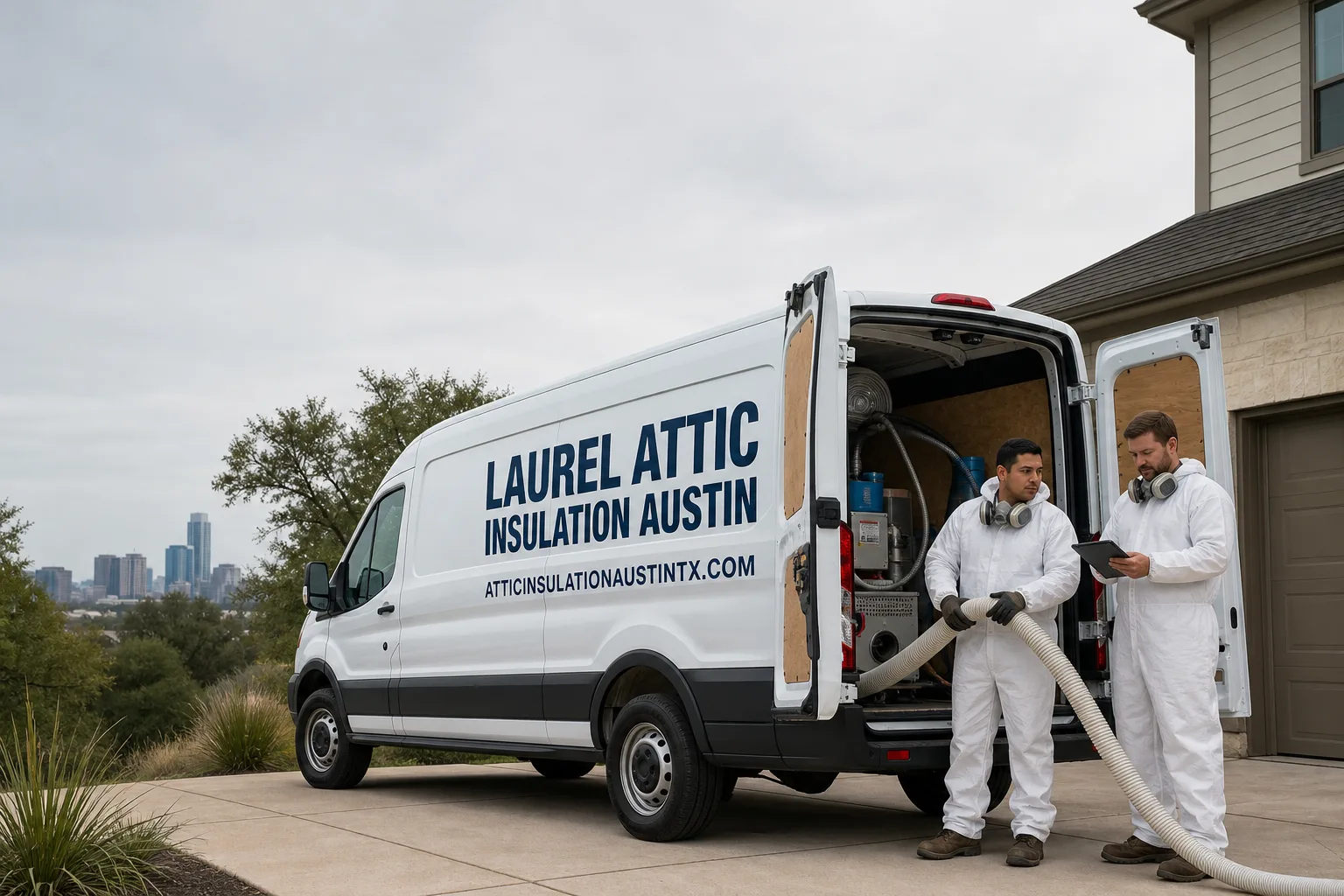
Fast, Reliable Insulation Removal Across Lost Creek
Insulation removal in Lost Creek usually runs $1.50 – $3.50 per square foot, with most full-attic jobs on those 1970s and 80s custom homes landing between $2,200 and $5,800 depending on access, contamination, and ceiling type. We’re Laurel Attic Insulation Austin, and we know Lost Creek’s homes better than most because we’ve crawled through enough of them to recognize the patterns: slumped R-11 batts over cathedral ceilings, squirrel damage near fascia boards, and unvented assemblies holding moisture against limestone-ledge terrain. When you call (361) 321-0817, you get a real person on our Insulation Removal team, not a callback queue. We dispatch locally, respond fast to Lost Creek, and put the job scope in writing before anything starts.
Why Laurel Attic Insulation Austin Is Lost Creek’s Preferred Insulation Removal Company
Lost Creek homeowners call us because we treat their custom homes like the one-off builds they are. These aren’t tract houses with cookie-cutter attics. We’ve worked on properties off Ledge Stone Drive, around the winding streets near Barton Creek, and along the tree-covered hillsides where every roofline is different. That matters when you’re removing contaminated insulation from a vaulted ceiling with limited access and finished drywall below.
Laurel Attic Insulation Austin runs on the Relay Visibility Guarantee, which means you get a live arrival time, before-and-after photo proof, and a written price before we touch a single batt. No vague four-hour windows. No door-step surprises. Every job also carries our 365-Day Done Right Promise: if the work isn’t right within a year, we fix it. Free. Chase Whitaker leads our team, and he’s built the way we schedule around one simple rule: treat a Lost Creek homeowner’s time like it’s actually valuable.
We’re part of the Relay Home Co. family, founded in 2003. That means we’re independently run, not a franchise pretending to care. Our technicians are background-checked and uniformed. You’ll know who’s walking onto your property. And when you call with a question at 2 a.m. because you found raccoon droppings in the attic, someone picks up. Live. 24/7.
Insulation Replacement in Lost Creek
Insulation Replacement in Lost Creek often means pulling out original R-11 kraft-faced fiberglass that has slumped, compressed, or absorbed decades of Texas humidity, then installing materials matched to the home’s actual thermal needs. These 1970s and 80s builds were insulated for a different era. Central Texas cooling loads have climbed, and the original batts in cathedral ceilings simply weren’t designed to handle the moisture and heat cycling Lost Creek’s hillside lots create. A full replacement in a standard attic here typically runs $1,800 – $4,900. Cathedral ceiling replacements run higher, usually $3,200 – $6,800, because of scaffolding, containment, and the precision required to avoid damaging finished drywall.
Cathedral Ceiling Batt Replacement
We remove old batts from vaulted ceiling cavities using containment and negative-pressure vacuums that keep dust out of living spaces. Then we assess the assembly itself. In Lost Creek, many older unvented ceilings need air sealing before new insulation goes in. Without it, moisture will just get trapped again.
Air Sealing Before New Installation
Heat and humidity move through gaps around recessed lights, wiring penetrations, and framing junctions. If we skip sealing, new insulation underperforms from day one. We seal first, then install insulation matched to the R-value the space actually needs. You get a written scope and a written guarantee on the work, not a handshake.
Attic Restoration in Lost Creek
Attic Restoration in Lost Creek goes beyond pulling out old material. It means returning a contaminated, heat-damaged, or animal-compromised attic to a clean, dry, thermally stable state. Lost Creek’s heavily wooded lots mean squirrels, rats, and raccoons are regular attic visitors. We remove contaminated insulation, sanitize the affected areas, seal entry points, and install fresh material. A full attic restoration in Lost Creek generally runs $3,000 – $7,500, depending on the extent of contamination, attic size, and whether we’re dealing with finished cathedral ceilings or standard attic access.
Contamination Removal and Sanitization
Squirrel droppings, urine-soaked batts, and decades of dust create conditions you don’t want your HVAC circulating through the house. We remove the affected insulation, treat the space, and verify it’s dry before new material goes in. You get photo documentation of the before, the during, and the after.
Entry Point Sealing
On a Lost Creek home near the hilly, tree-covered lots off Ledge Stone Drive, our crew removed squirrel-chewed and contaminated Owens Corning R-11 batts from a cathedral ceiling. We found hidden thermal bypasses around the fascia boards where squirrels had gnawed their way in. We sealed those entry points, managed the vapor profile of the unvented assembly, and installed a retrofit suited to the complex roofline. That’s the difference between removal and restoration. We don’t leave the door open for round two.
Trusted Brands We Service in Lost Creek
Most Lost Creek homes we work on originally used Owens Corning or Johns Manville fiberglass, and many have newer Knauf or Rockwool retrofits layered in over the years. We service all of them, and we stock common replacement materials locally so Lost Creek jobs don’t stall waiting on parts from a distributor across town. If your attic has a patched-together mix of brands and eras, we’ll sort out what’s salvageable and what needs to come out. We spec the material to the job, not to whatever’s on the truck.
Common Insulation Removal Problems We See in Lost Creek Homes
- Slumped R-11 batts in cathedral ceilings: Original kraft-faced insulation loses loft after 40-plus years of heat cycling. In Lost Creek’s unvented ceiling assemblies, that means thermal gaps and trapped condensation.
- Squirrel-chewed entry points around fascia boards: The tree canopy is beautiful until it becomes a rodent highway. Chewed entry points let animals nest in your insulation, contaminating it with droppings and urine.
- Hidden moisture against limestone-ledge terrain: Hillside lots retain more ground moisture than flat subdivisions. Paired with heavy tree shading, that means attics here stay damp longer, degrading insulation faster.
- Ineffective flat-attic removal techniques on vaulted spaces: Contractors who treat a cathedral ceiling like a standard attic leave material behind. In Lost Creek’s custom homes, that oversimplified approach causes incomplete removal and trapped moisture that rots framing.
Pricing for Insulation Removal in Lost Creek, TX
A typical attic insulation removal in Lost Creek runs $2,200 – $5,800. Attic restoration with sanitization and entry-point sealing adds $800 – $2,000. Cathedral ceiling removals average $3,200 – $6,800 because of the access work and finished-space protection involved. Factors that shift the number: attic square footage, contamination level, ceiling type, and how many entry points need sealing. We give you a written price before any work starts. That’s not an estimate with fine print. It’s the number. Call (361) 321-0817 for a free, no-pressure quote. We’ll come out, look at your attic, and tell you exactly what’s needed and what it costs.
We Also Serve Cities Near Lost Creek
Our Lost Creek customers refer us to friends across the area, and we cover the surrounding metros too. We handle insulation removal in Austin, Pflugerville, San Marcos, and Taylor with the same local dispatch and same written-pricing guarantee. If you’re in one of those cities and dealing with a contaminated or failing attic, the process is identical: call, schedule, get a live arrival time, and see photo proof before you pay.
Serving Lost Creek, TX - Our Local Coverage Area
We’re based in the Lost Creek area and know this community well. Use the map below to see our service coverage - if you’re nearby, we can almost certainly help.
FAQs About Insulation Removal in Lost Creek
Lost Creek’s custom 1970s and 80s homes often have unvented cathedral ceiling assemblies over limestone-ledge lots, where original R-11 kraft-faced batts have slumped and trapped condensation. Flatter, newer Austin subdivisions typically have vented attics and standard access, making removal more straightforward there. In Lost Creek, we’re dealing with vaulted spaces, finished drywall below, and moisture dynamics that require air sealing and vapor management alongside removal. Call (361) 321-0817 and we’ll assess your specific roof assembly in person, free.
Squirrel infestations contaminate insulation with droppings, urine, and nesting material, which means the affected material has to be removed rather than topped off or left in place. We also have to find and seal the entry points around fascia boards, soffits, and roofline gaps, otherwise the problem returns within weeks. The removal itself is only half the job. The sealing is what protects the new insulation. We include entry-point sealing in every contaminated-attic scope for Lost Creek homes.
Yes. We use containment systems and negative-pressure vacuums that pull old insulation out through small access points without cutting large holes in your drywall. The process takes longer than a standard attic removal and costs more, but it protects the custom finishes Lost Creek homes are known for. We’ve done this repeatedly on vaulted ceilings off Ledge Stone Drive and throughout the neighborhood. You’ll see photo proof of the before and after before you pay.
Air sealing closes the gaps that let hot, humid air move through your ceiling into conditioned space. In Lost Creek’s unvented cathedral assemblies, skipping air sealing means the new insulation gets wet and degrades within a few seasons. The shade from Lost Creek’s tree canopy reduces solar drying, so moisture lingers longer here than on exposed lots. Sealing first, then insulating, is the only sequence that holds up. We write it into every restoration scope, in writing, before work starts.
Most Lost Creek homes from the 1970s and 80s have original Owens Corning or Johns Manville R-11 kraft-faced fiberglass batts, often now slumped and compacted. We also find later blow-in fiberglass or cellulose retrofits layered over the original batts, and occasionally early spray foam that has failed or been improperly applied. Each material requires a different removal method and containment strategy. We’ll identify what’s in your attic during the free estimate. Call (361) 321-0817 to schedule.
Written by Chase Whitaker, Owner at Laurel Attic Insulation Austin, serving Lost Creek and the surrounding Central Texas area.