
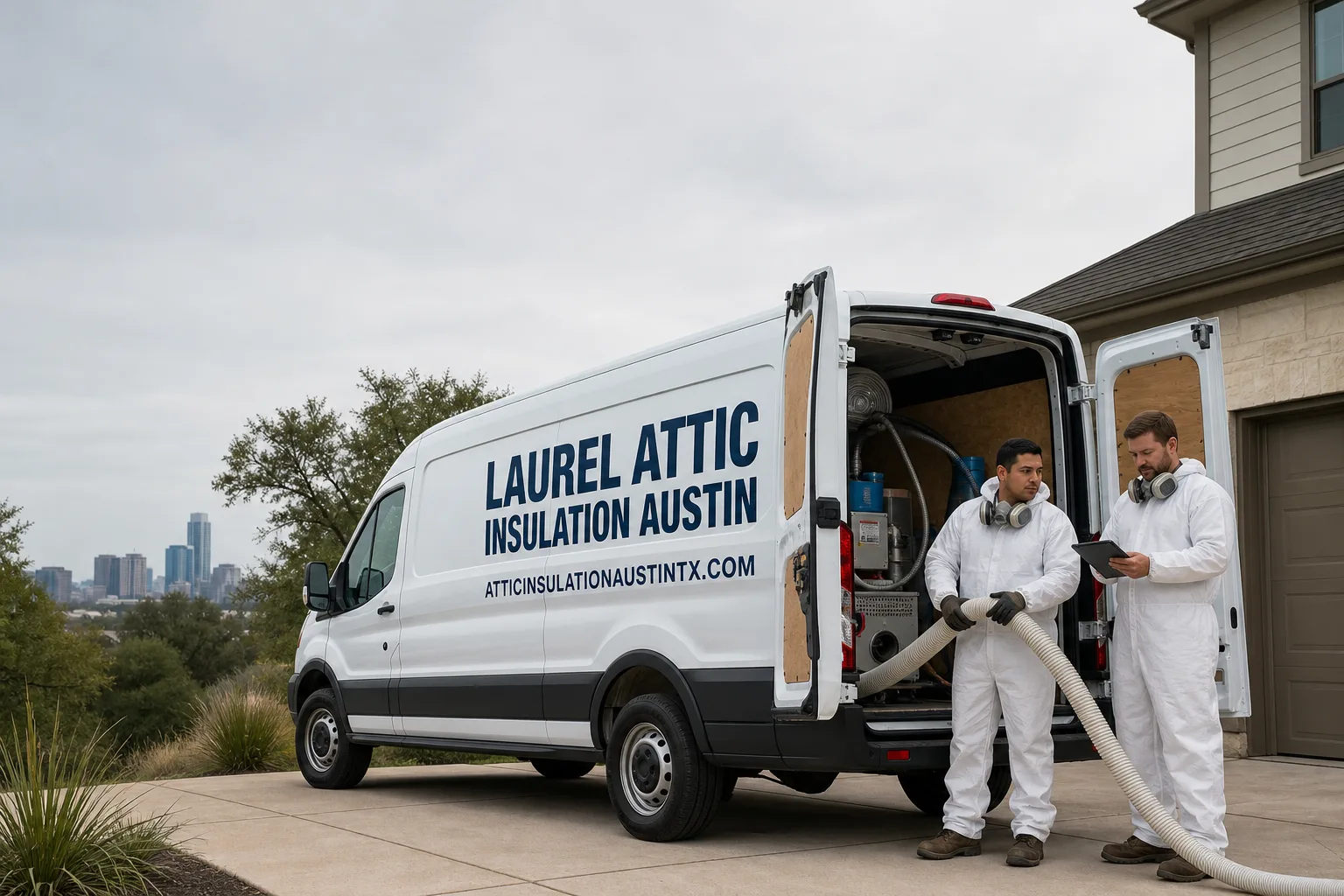
How Much Does Attic Insulation Cost in Austin?
Our Attic Insulation services in Austin, TX typically cost $1,650 to $3,900 for a full attic in 2026, with most homeowners paying around $2,200 for blown-in fiberglass covering roughly 1,500 square feet at R-38. Smaller jobs like topping off existing insulation run $650 to $1,200, while spray foam in an average Austin attic lands between $3,500 and $7,500. The final number depends on square footage, current insulation depth, R-value target, and material type.
We’ve been handling Attic Insulation Near Me in Austin, TX since 2003, and these ranges reflect what we actually quote on jobs in Hyde Park, Mueller, Circle C, and beyond. Call (361) 321-0817 and we’ll give you a written price before any work starts.
Attic Insulation Cost Breakdown (2026)
Here’s what our team sees on real Austin jobs. These are the line items that make up a typical attic insulation quote:
| Item | Typical Cost in Austin | Notes |
|---|---|---|
| Blown-in fiberglass (R-38, 1,500 sq ft) | $1,800 – $2,600 | Most common Austin retrofit; Owens Corning AttiCat or Johns Manville Climate Pro |
| Blown-in cellulose (R-38, 1,500 sq ft) | $1,650 – $2,400 | GreenFiber or Knauf Jet Stream; slightly cheaper, handles better in wind |
| Topping off existing insulation to R-38 | $650 – $1,200 | Adds 6-10 inches over existing material; no removal needed |
| Open-cell spray foam (R-21, roof deck) | $3,500 – $5,500 | Icynene or Demilec; seals air, used in unvented attics |
| Closed-cell spray foam (R-38, roof deck) | $5,000 – $7,500 | Higher R-value per inch; Demilec or CertainTeed CertaSpray |
| Insulation removal (old or contaminated batt) | $800 – $1,800 | Per average 1,200 sq ft attic; includes vacuum removal and bagging |
| Air sealing before insulation | $350 – $700 | Can lights, top plates, chase ways; strongly recommended in Austin heat |
| Radiant barrier (optional add-on) | $1,100 – $2,200 | Reflects heat before it reaches insulation; popular in Texas attics |
| Attic baffles and venting repairs | $120 – $400 | Keeps soffit vents clear so your insulation actually works |
Those are real numbers from Austin jobs we’ve quoted in 2025 and early 2026. What shifts the total: how much is already up there, whether you need removal first, whether you want air sealing, and how accessible your attic is. A 900 sq ft attic in a Crestview ranch will cost less than a 2,300 sq ft attic in Steiner Ranch with a steep pitch and a tight scuttle.
One thing that doesn’t shift: our price. Laurel gives you a written price before anything starts. That’s the Relay Visibility Guarantee and it’s included on every single job we do in Austin.
What Affects Attic Insulation Pricing in Austin
Austin has a few quirks that move the number around. Here’s what matters:
- Current insulation depth. Most Austin homes built before 2000 have 4-6 inches of old fiberglass, roughly R-11 to R-19. Austin Energy recommends R-38 minimum. If you’re at R-19, topping off to R-38 costs a third of what a full re-insulation does.
- Attic accessibility and layout. Low-slope roofs in older South Austin bungalows mean tight spaces. Hip roofs with lots of angles in Tarrytown and Westlake add labor hours. The crew has to physically haul material to every corner.
- Material type and R-value target. R-38 blown-in runs $1.20-$1.70 per sq ft installed in Austin. R-49, which we recommend for north-facing homes in Round Rock and Cedar Park border areas, adds maybe $300-$500 to a typical job. Spray foam is 2.5x to 3x the cost but adds structural rigidity and air sealing in one pass.
- Air sealing scope. In Austin’s 100-degree summers, gaps around can lights, plumbing stacks, and top plates leak conditioned air into the attic. Sealing them before blowing insulation is the cheapest efficiency bump you’ll ever buy. Expect $350-$700 on an average single-story home.
- Removal needs. Rodent damage, water stains from hail storms, or 1970s vermiculite (yes, we still see it in Allandale and Brentwood) means pulling old material first. That adds $800-$1,800 and usually a half day of labor.
- Seasonal demand. Austin insulation pricing ticks up 5-10% in late spring and early summer when everyone notices their AC running nonstop. Booking in fall or winter doesn’t just save money; crews are more available and the attic is bearable for our techs.
How Much Does Attic Insulation Save on Austin Energy Bills?
Going from R-19 to R-38 in an Austin attic typically cuts cooling costs by 10% to 15% per year. On an average Austin home paying $180/month to Austin Energy for electricity, that’s $216 to $324 back in your pocket annually, which means the insulation pays for itself in 6 to 9 years at current material prices.
Beyond dollars, there’s comfort. Austin attics hit 130-150°F in July and August without proper insulation. Blown-in fiberglass at R-38 knocks that ceiling-to-living-space heat transfer down enough that your AC stops cycling so hard in the evenings. Homeowners in Mueller and Domain-area neighborhoods tell us they notice the difference the first summer night after install.
How to Save on Attic Insulation
Saving money on attic insulation in Austin isn’t about cutting corners, it’s about timing and targeting the right scope. Here’s what actually works:
- Insulate in fall or winter. Austin winters are mild and crews move faster in a cool attic. You’ll often see 5-10% lower labor rates from November through February.
- Check Austin Energy rebates first. Austin Energy has offered insulation rebates of up to $500 for qualifying attic upgrades in recent program years. Rebates shift with program funding, so call them or ask us; we’ll tell you honestly what’s active when you call.
- Top off before you tear out. If you’ve got R-19 already and no rodent or moisture damage, you don’t need removal. Adding R-19 on top gets you to R-38 for a fraction of the cost of a full redo. Most Austin homes fall into this category.
- Air seal in the same visit. Bundling air sealing with insulation beats doing them separately. You pay one trip charge, one equipment setup, and the sealing compounds the insulation benefit. It’s the highest ROI step on this list.
- Get a real quote. Honestly, the biggest savings mistake we see is hiring someone who quotes over the phone without looking at the attic. Our estimates are free. We come out, measure, check your existing R-value, look at venting, and then give you a written price. Call (361) 321-0817 to schedule one.
Attic Insulation Materials Explained
You’ll hear trade terms tossed around. Here’s what they mean for your wallet and your attic:
Blown-in Fiberglass
What’s in the bag: Owens Corning AttiCat or Johns Manville Climate Pro. We blow it in with a machine that fluffs the fibers for maximum R-value per inch. It’s the most common Austin retrofit because it’s fast, effective, and hits R-38 for around $1.20-$1.70 per sq ft installed. It settles about 1-2% over time, so we install slightly over target depth.
Blown-in Cellulose
What’s in the bag: GreenFiber or Knauf Jet Stream, made from recycled paper mill fiber treated with borate for fire and pest resistance. It costs 5-15% less than fiberglass in Austin and does a better job blocking air movement if you skip air sealing. R-value per inch is slightly higher than fiberglass: 3.2-3.8 per inch versus 2.2-2.9.
Spray Foam (Open-Cell and Closed-Cell)
Open-cell runs about $0.50-$0.80 per board foot in Austin. It’s the foam you’d spray on the roof deck of an unvented attic. It air-seals completely and hits R-3.5 per inch, meaning six inches gets you R-21, which is plenty for Texas climate zones.
Closed-cell costs $1.00-$1.50 per board foot and hits R-6.5 per inch. We use Demilec or CertainTeed CertaSpray for closed-cell. It’s the premium option: adds structural rigidity, blocks moisture vapor, and insulates better per inch. For Austin’s hot-humid climate, open-cell is usually sufficient unless you need the moisture barrier or structural bonus.
Spray foam is a different animal. The material expands rapidly and the chemical reaction generates heat. This is not a DIY product. A bad spray foam job can off-gas, shrink, or fail to cure properly. If you’re going this route, use a crew that does it every week, not once a quarter.
Batt Insulation (Fiberglass and Rockwool)
Batt is what you see in new construction: pre-cut blankets of fiberglass or Rockwool laid between joists. For existing Austin attics, we rarely recommend batt for the main floor because it leaves gaps around wiring and plumbing. But for knee walls, scuttle doors, and tight areas where a blower hose won’t reach, batt is the right tool. Rockwool ComfortBatt runs about $1.10-$1.40 per sq ft in Austin and adds real fire resistance.
How Does R-Value Actually Work in Austin?
R-value is the number that measures how well insulation slows heat from moving through your ceiling. Higher R-value means better resistance. Austin sits in IECC Climate Zone 2A, where the code minimum for attic insulation is R-38 for new construction. Many Austin homes built 20 or 30 years ago sit below that; we routinely find R-11 or R-19 in Lakewood, Gracywoods, and older parts of Pflugerville.
Here’s the thing: R-value isn’t linear in the Texas heat. Going from R-11 to R-19 saves more energy than going from R-19 to R-38, because the biggest jump in resistance happens at the start. But R-38 is still the target because your ceiling is a thin membrane between 75-degree living space and a 140-degree attic. The heat load difference is enormous.
If you want exact numbers for your home, we’ll measure your current depth during the free estimate and tell you what R-value you’re actually sitting at.
Attic Insulation and Austin’s Climate: What Actually Happens Up There
Austin gets 2,300 hours of sunshine a year and summer highs routinely hit 100°F from late June through early September. Your attic, sitting under a dark asphalt shingle roof, absorbs that heat all day and radiates it down through your ceiling all night. That’s why Austin attics can stay warm until midnight in August, and why your AC runs from 2 p.m. to 4 a.m. without a break.
We’ve measured attic deck temperatures of 150°F+ in Bouldin Creek and Travis Heights homes with old batt insulation. After installing R-38 blown-in plus a radiant barrier, attic air temps drop 20-30 degrees and ceilings stop radiating heat by early evening. That’s not marketing talk; that’s a before-and-after reading from a Fluke infrared gun, and we show you the photos.
Winter is less dramatic but not nothing. Austin freezes hit 5-10 nights a year. In homes with R-11 ceilings, heat pours through the attic during a freeze. Proper insulation keeps that heat in and keeps your heater from cycling constantly during a February cold snap.
There’s also the hail factor. Austin sees hailstorms often enough that roof replacements are routine throughout Cedar Park, Leander, and Round Rock neighborhoods. After a roof replacement, attic insulation often gets disturbed, compressed, or filled with shingle debris. If you’re getting a new roof, have the attic checked before insulation gets buried under roofing work.
Signs Your Austin Attic Needs More Insulation
Here’s how to tell if your current insulation is falling short. None of these require climbing into the attic; most you can spot from your living room:
- Second-story rooms run 5-8°F warmer than downstairs in summer. That’s heat from the attic pressing through the ceiling. In Mueller and Circle C two-story homes, this is the most common complaint we hear.
- Your AC runs continuously from mid-afternoon to sunset. If your unit can’t hold 78°F when it’s 100°F outside, the attic is likely loading the house with heat.
- Ice dams or condensation in the attic. Rare in Austin but not unheard of during hard freezes. Frost on nails means warm, moist air is leaking into the attic and meeting cold decking. Air sealing fixes this.
- You can see ceiling joists above the insulation. Joists are typically 6-9 inches tall. If they’re visible, you’re below R-19 and well under the R-38 target.
- Energy bills that climb every summer. Austin Energy rates haven’t dropped, but insulation that’s compressed, settled, or rodent-damaged loses effectiveness over time. A 15-year-old fiberglass install is often doing half its original job.
Why We Do Air Sealing Before Insulation
Air sealing is the step most insulation contractors skip in Austin. We won’t skip it, because sealing gaps before blowing insulation is the difference between an attic that performs and an attic that just looks full.
In a typical 1970s-1990s Austin home, you’ve got dozens of air leak points: recessed can lights, bathroom fan housings, plumbing vent stacks, wall top plates, and the chase that carries your AC lines. Each one lets conditioned air from your living space escape into the attic. In summer, that’s cooled air leaking out while superheated attic air gets pulled in through gaps around doors and windows.
We seal these with fire-rated foam or caulk before we blow in insulation. It takes our crew an hour or two on most homes and costs $350-$700, depending on how many leak points and how accessible they are. If you’ve got older recessed lights that aren’t IC-rated, we’ll flag them and talk through your options because covering non-IC fixtures with insulation can be a fire hazard.
On every air sealing and insulation job, we document the work with photos before and after. You see what we sealed and exactly how much insulation went in. That’s the Relay Visibility Guarantee in action: live arrival tracking, before-and-after photo updates, and a written price before anything starts.
How Laurel Attic Insulation Austin Works
Chase Whitaker runs our Austin crew, and the way we work is built around one idea: your time and your money should never be a mystery. Here’s how an attic insulation job goes when you hire us:
- You call or tap to book. A live person answers 24/7, no voicemail, no callback queue. You tell us your address and what you’re seeing: hot rooms, high bills, old insulation, whatever.
- We come out and measure. A background-checked, uniformed tech arrives at a live, trackable time; not a vague four-hour window. We measure square footage, check current R-value, inspect venting, and look for air leaks.
- You get a written price. Before we touch anything, you get the full scope and price in writing. No door-step surprises, ever.
- We do the work. Our crew installs the agreed materials: blown-in fiberglass, cellulose, spray foam, or whatever we specified. You get before-and-after photos of the actual job.
- You pay from the link. Digital invoice, written guarantee attached. If anything’s not right within 365 days, the 365-Day Done Right Promise has you covered. That means the repair is on us, and if the repair fails, we come back free.
We’ve been doing this in Austin since 2003 as part of the Relay Home Co. family of local home-service businesses. Laurel stays green all year; so should your home’s comfort. That’s the idea behind the name.
Which Insulation Material Is Right for Your Austin Home?
Here’s a quick decision guide based on what we see in different parts of Austin:
- Older single-story homes (Hyde Park, Bouldin Creek, Crestview, Allandale): Low clearance attics with original batt or vermiculite. Most of these need removal first, then blown-in fiberglass or cellulose at R-38. If the attic is unvented or you’re converting it, open-cell spray foam on the roof deck.
- Two-story suburban homes (Circle C, Steiner Ranch, Avery Ranch): Large, open attics with plenty of clearance. Blown-in fiberglass at R-38 or R-49 is the value play. Add air sealing and consider radiant barrier under the roof deck for serious summer comfort.
- Newer 2000s+ builds (Avery Ranch, Mueller, Domain area): Most came with R-30, which is close but not quite R-38. Topping off with 3-4 inches of blown-in gets you to R-38 for around $650-$1,200. This is the cheapest efficiency upgrade on the Austin market.
- Homes with ductwork in the attic: Very common in Texas. Your ducts sit in a 140°F attic, which means the cold air they carry warms up before it reaches your vents. Air sealing and adding R-38 reduces the attic air temp around the ducts, directly improving AC performance.
- Older homes with knob-and-tube wiring: We still see this in Allandale, Ridgetop, and parts of Hyde Park. Insulation cannot be blown over live knob-and-tube wiring without serious fire risk. We’ll flag it and recommend a licensed electrician evaluate before we touch the attic.
Not sure which category you’re in? Call (361) 321-0817. We’ll talk it through and schedule a free on-site look.
FAQs – Attic Insulation Cost
How much does attic insulation cost in Austin?
Most Austin attic insulation jobs cost $1,650 to $3,900 depending on square footage, material, and R-value target. Topping off existing insulation runs $650 to $1,200. Spray foam runs $3,500 to $7,500 for an average attic. Call (361) 321-0817 for a free, written quote on your specific home.
Is it cheaper to repair or replace attic insulation in Austin?
If your existing insulation is dry, uncompressed, and pest-free, topping off is far cheaper. You’re adding 6-10 inches over existing material to reach R-38 for $650 to $1,200 rather than paying $1,800-$2,600 for a full removal and reinstall. Attic Insulation Replacement only makes sense if the old material is water-damaged, rodent-infested, or contaminated. Most Austin homes need topping off, not full replacement.
How much does spray foam insulation cost in Austin?
Open-cell spray foam runs $3,500 to $5,500 for a typical 1,500 sq ft Austin attic at R-21. Closed-cell runs $5,000 to $7,500 at R-38 on the roof deck. Spray foam costs more upfront but air-seals completely and often eliminates the need for separate air sealing. Call (361) 321-0817 for an exact quote; estimates are free.
What R-value does Austin require for attic insulation?
Austin falls under IECC Climate Zone 2A, which requires R-38 minimum for attic insulation in new construction. Most older Austin homes have R-11 to R-19. We recommend R-38 minimum, and R-49 if you want maximum summer performance. We’ll measure your current R-value free during our estimate.
Can you insulate my Austin attic the same week I call?
In most cases, yes. Our Austin schedule runs 2-5 days out year-round, and we keep emergency slots for urgent situations. Same-day service is possible if you call early. Live phone support is available 24/7 at (361) 321-0817; call and we’ll sort the soonest time that works.
Does attic insulation really make a difference in Austin summers?
Yes. Going from R-19 to R-38 typically cuts annual cooling costs 10-15% and drops second-story temps by 5-8°F. In Austin’s 100-degree summers, that’s the difference between your AC running constantly from 2 p.m. and cycling off in the evening. We’ve measured attic temps before and after install with infrared; the drop is real and we show you the photos.
Do I need to remove old insulation before adding new?
Not usually. If your existing insulation is dry, uncontaminated, and free of rodent damage, we blow new insulation right on top. Removal is only necessary for water damage, mold, rodent infestations, or pre-1970s vermiculite. Removal adds $800-$1,800 to the total on an average Austin attic.
Get Your Austin Attic Insulation Quote
The fastest way to know what your attic will cost is to let us look at it. Our estimates are free, take about 45 minutes, and end with a written price in your hand before anything starts. That includes air sealing recommendations, current R-value measurement, and a full scope of work.
Call (361) 321-0817 now or any time; a live person answers 24/7. Chase Whitaker and our Austin crew will get you a straight answer, a written price, and a cooler upstairs by the end of the week.
Written by Chase Whitaker, Owner at Laurel Attic Insulation Austin, serving Austin since 2003.
Pricing reflects the Austin market as of 2026. Laurel Attic Insulation Austin offers free estimates – call (361) 321-0817.
What Our Customers Say
"Quote in the app was clear on R-value and price."
- Doris L."Booked a quote online and got a text when the crew was on its way. Blown-in insulation went in quickly and they sent before and after photos."
- Ron D."Spray foam in the crawl space. Floors feel warmer."
- Joanna S.