
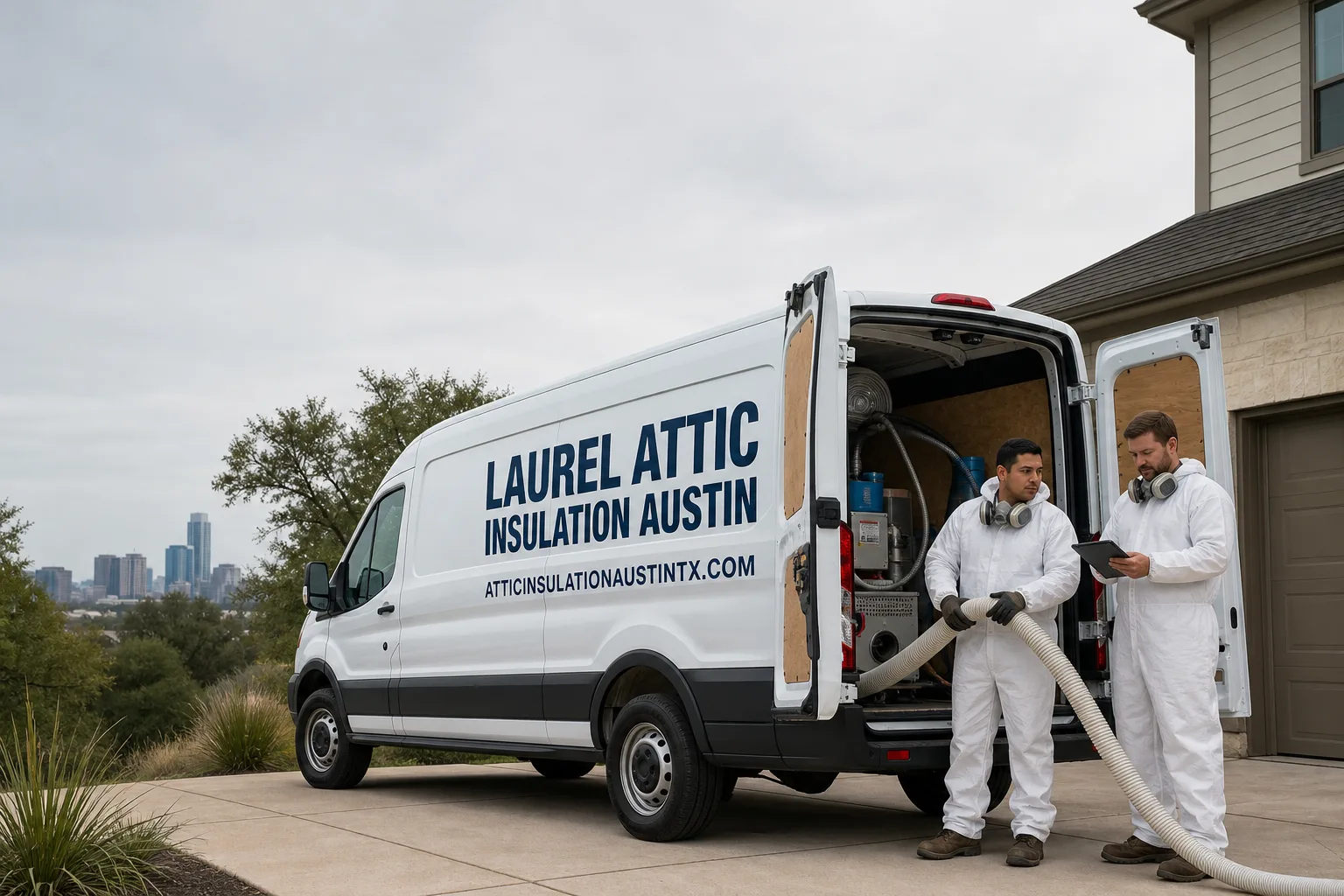
How Much Does Insulation Cost in Austin?
Most attic insulation jobs in Austin run between $1,200 and $4,800, with the typical single-family home landing around $2,400 for blown-in fiberglass or cellulose at R-30 to R-38. Spray foam insulation costs more, usually $3,500 to $9,000 for a standard attic, but delivers roughly twice the R-value per inch. The exact number depends on your square footage, what’s already up there, and whether old insulation needs to come out first.
Insulation cost in Austin breaks down into three buckets: attic insulation (the most common job we do), spray foam (higher performance, higher price), and insulation removal (needed before a clean reinstall, or after a roof leak, pest infestation, or a botched earlier job). Laurel Attic Insulation has been pricing these jobs across Austin since 2003, and the numbers below reflect what we actually see in neighborhoods like Allandale, Mueller, Circle C, and East Austin in 2026.
Insulation Cost Breakdown (2026)
Here’s a straight answer, the kind you’d get if you called and asked. These ranges cover the majority of Austin homes built between the 1960s and the early 2000s, which is where most of our work happens.
| Insulation Type | Typical Cost Range (Austin, 2026) | Best For |
|---|---|---|
| Blown-in fiberglass (attic, R-30 to R-38) | $1,200 – $2,800 | Most standard attics, 1,200 – 2,000 sq ft home |
| Blown-in cellulose (attic, R-30 to R-38) | $1,400 – $3,200 | Slightly better air-sealing than fiberglass, recycled content |
| Batt fiberglass (attic, R-30) | $800 – $2,400 | Smaller attics, easy access, budget-friendly |
| Spray foam, open-cell (attic roof deck) | $3,500 – $7,000 | Unvented attics, ductwork in attic, homes that trap heat |
| Spray foam, closed-cell (attic roof deck or walls) | $4,500 – $9,000 | Highest R-value per inch, moisture barrier, HVAC in attic |
| Insulation removal (per attic) | $400 – $1,500 | Aged, pest-damaged, or water-damaged insulation |
| Air sealing (before new insulation) | $300 – $900 | Gaps around can lights, plumbing penetrations, top plates |
Those numbers assume a single-story home with accessible attic space and no major surprises like extensive rodent cleanup or roof deck repairs. Two-story homes with a single attic cost about the same as single-story; homes with multiple attic zones (common in 1970s splits) can run 15 – 25% higher because the crew spends more time getting material into tight spaces.
What Affects Insulation Pricing in Austin
Here’s what moves the number when we quote a job. None of these are “gotcha” factors – they’re things you can see in your own attic before you call.
- R-value required. R-value is the number that measures how well insulation slows heat from moving through your ceiling. Austin is in climate zone 2, so the 2021 IECC code baseline for attics is R-38, up from R-30 in older homes. If your attic has R-19 or less (common in pre-1990 Austin builds), you’re paying to cool the sky. Adding R-38 over an old R-19 blanket costs less than a full removal and reinstall.
- Attic square footage and accessibility. A 1,500-square-foot attic costs less to insulate than a 3,000-square-foot one, obviously. But geometry matters too. Low-slope roofs (plenty of these in Allandale and Brentwood) leave tight crawl spaces that slow a crew down. Flat or low-pitch roofs over 1970s ranch houses in Northwest Hills can add 10 – 20% in labor.
- What’s already up there. If your existing insulation is dry, settled, and older than 20 years but not damaged, we can blow new material right over it in most cases – that’s the cheapest path. If there’s water staining from a past roof leak, rodent droppings (very common in Lake Travis-area homes), or old batt insulation that’s fallen apart, removal adds cost but prevents sealing problems into a brand-new layer.
- Air sealing before the job. Insulation slows heat, but air sealing stops it from moving through leaks. Every Austin attic has penetrations: recessed light housings, plumbing vents, flue chases, and dropped soffits above kitchen cabinets. Sealing these before blowing insulation typically adds $300 – $900 and makes a bigger comfort difference than adding another 6 inches of material. Skipping it is false economy.
- HVAC and ductwork location. Austin homes put air handlers and ducts in attics constantly – it’s the single biggest difference between our market and the Midwest. When your air conditioner is in a 140-degree attic, insulation isn’t just about the living space; it’s about surrounding that equipment. Homes where we’re insulating roof decks to create a conditioned attic pay more upfront but cut cooling costs dramatically from July through September.
- Material choice. We install materials from eight manufacturers – Owens Corning, Johns Manville, Knauf, Rockwool, CertainTeed, Icynene, Demilec, and GreenFiber – and we match the material to the job, not to whatever’s left on the truck. Standard blown fiberglass is the price baseline; cellulose runs slightly higher; Rockwool batts run higher still for their fire and sound properties; spray foam is the premium option, and open-cell is always cheaper than closed-cell at the same thickness.
One thing that does not change: the price we write down before the work starts. That’s the Relay Visibility Guarantee, and it means the number you agree to is the number you pay. No surprise line items at the door, no “we found something while we were up there” upcharge without your sign-off. Laurel Attic Insulation was built into the Relay Home Co. family in 2003 with that principle baked in, and it’s still the way every job gets priced.
Is Spray Foam Worth the Higher Cost in Austin?
Short answer: for a lot of Austin homes, yes – if you plan to stay more than five years. Spray foam costs roughly 2.5 – 3 times what blown-in fiberglass costs per square foot, but the payback in our climate is real. Austin summers push attic temperatures past 130°F routinely, and when your ductwork lives in that heat, your AC is fighting an uphill battle from the moment it kicks on.
Here’s the math we share with homeowners. A blown-in fiberglass attic at R-38 slows heat but still lets the attic get hot – it just keeps more of that heat from reaching the living space. Open-cell spray foam on the roof deck turns the attic into a conditioned space, meaning your ducts are suddenly sitting in air that’s 85°F instead of 130°F. The Department of Energy’s own studies put cooling savings from ductwork in conditioned space at 15 – 20% in hot climates. On a $250 summer electric bill, that’s $450 – $600 a year. At a $5,000 premium for spray foam, the payback lands right around that five-year mark, sooner if you also air-seal.
Spray foam also insulates and air-seals in a single step, which is why it performs so well in older Austin pier-and-beam houses with leaky wall cavities and in homes with vaulted or cathedral ceilings where there’s no flat attic floor to blow material onto.
Chase Whitaker, who runs Laurel Attic Insulation Austin, is direct about this calculation: “Closed-cell is the best product in the industry, full stop. But I’ve talked homeowners out of it when their budget was tighter and their attic was a simple rectangle. The honest answer is that a well-air-sealed R-38 blown attic beats a bare R-19 attic every single day, and it costs a fraction of what foam does.”
How to Save on Insulation in Austin
Insulation is one of the few home improvements that pays for itself, but you don’t have to spend top dollar to get real results. Here’s what we recommend:
- Check your rebate eligibility. Austin Energy runs a residential insulation rebate program for homes that meet their efficiency requirements. The numbers change year to year, but rebates on attic insulation upgrades have historically been in the $400 – $1,000 range for qualifying homes. Austin Energy also offers free home energy audits through their E-CAB (Energy Conservation Audit and Disclosure) program for homes inside city limits – that’s the cheapest first step, and it gives you a professional third-party readout of your current R-value.
- Blow over existing insulation if it’s still sound. If your current insulation is dry and uncontaminated, topping it off is 40 – 60% cheaper than removing and starting fresh. We only recommend removal when there’s damage – water, pests, or significant compression from age.
- Pair air sealing with any new insulation. Sealing is the cheapest part of the job and delivers the biggest comfort return per dollar spent. It’s easy to skip, and every contractor knows it. Don’t skip it.
- Get a written price before you commit. This should be the baseline expectation for any trade, but insulation is especially prone to “per square foot” math that changes between the estimate and the invoice. Call (361) 321-0817 and we’ll give you a written price before anything starts – that’s not a promotion, that’s just how Laurel works.
- Don’t wait until August. This is a practical tip, not a gimmick. Austin insulation companies are slammed from June through September because everyone notices their electric bill at the same time. Booking in the spring (or right now, in the off-season) means faster scheduling, more availability for your preferred material, and sometimes better pricing when crews aren’t running overtime.
FAQs – Insulation Cost
How much does it cost to insulate a 1,500 sq ft attic in Austin?
Expect $900 – $2,200 for blown-in fiberglass or cellulose at R-38 in a 1,500-square-foot attic, assuming access is standard and no removal is needed. If you’re topping off existing insulation, it may come in lower; if you need removal or air sealing first, it may run slightly higher. Call (361) 321-0817 for a written quote based on your specific attic – estimates are free.
Is spray foam insulation worth the cost in Austin?
At $3,500 – $9,000 for a standard attic, spray foam runs 2.5 – 3 times the cost of blown-in insulation. The payoff comes from moving your ductwork into a conditioned space, which typically cuts cooling costs 15 – 20% in Austin’s hot climate – enough to recover the premium in about five years. If you’re staying long-term or your HVAC is in the attic, it’s often worth it.
Can you insulate my attic the same day?
In most cases, yes. A standard blown-in attic job (1,500 – 2,000 sq ft) takes one crew 3 – 6 hours, so we can usually schedule it the same week – and often same-day when our schedule allows. Spray foam jobs take a bit longer because the foam needs time to cure before re-entry. Call (361) 321-0817 and we’ll give you a time window, not a vague “sometime next week.”
What R-value do I need in an Austin attic?
The 2021 IECC code minimum for climate zone 2 (Austin) is R-38 in attic floors. Homes built before 1990 often have R-19 or less, which means they’re losing heat at roughly double the rate they should be. For roof decks and conditioned attics, closed-cell spray foam at R-20 – R-24 performs as well as or better than R-38 on the floor because it also air-seals.
How much does insulation removal cost in Austin?
Expect $400 – $1,500 for a standard attic removal, depending on square footage, material type, and access. Removal is needed when insulation is water-damaged, pest-infested, or so old it’s no longer performing. The 365-Day Done Right Promise means if the removal job isn’t done right – debris left behind, damage to the attic floor, incomplete clearance – we make it right, in writing.
Is it cheaper to repair or replace attic insulation?
In insulation, “repair” usually means “top off” – adding new material over existing. Topping off costs 40 – 60% less than full removal and replacement, so it’s the cheaper path whenever the old material is still dry and structurally sound. If there’s moisture damage or pest contamination, replacement is the only real option; the old material has to come out or the new layer gets compromised.
Why Austin Homeowners Choose Laurel Attic Insulation
Insulation is one of those trades where you can’t see the work, can’t verify the R-value with your own eyes, and can’t tell if you got what you paid for until the first 100-degree day. That’s why the guarantee matters more than the marketing.
Laurel Attic Insulation is the insulation specialist inside the Relay Home Co. family, founded in 2003 and led by Chase Whitaker. We install professional-grade materials from Owens Corning, Johns Manville, Knauf, Rockwool, CertainTeed, Icynene, Demilec, and GreenFiber – and we put every job through the Relay Standard: a written price before work begins, a live arrival time instead of a four-hour window, before-and-after photos of the actual attic, and a digital invoice you can pay from a link. No door-knock price changes, no “we’ll come back and finish that tomorrow” follow-ups, no mystery about whether the crew actually showed up.
The name matters too. Laurel stays green all year – so should your home’s comfort. That’s the idea, and the standard we hold every job to.
Every Laurel job also carries the 365-Day Done Right Promise: if the work isn’t done right within a full year, we make it right – free second visit, no charge, no argument. That’s in writing, on every job, including yours.
If you’re in Austin and want a straight answer on what your attic needs and what it’ll cost, call Laurel Attic Insulation at (361) 321-0817. A live person answers, 24/7 – no voicemail, no callback queue. We’ll give you a written price before anything starts, and the number you agree to is the number you pay.
Pricing reflects the Austin market as of 2026. Laurel Attic Insulation Austin offers free estimates – call (361) 321-0817.
Written by Chase Whitaker, Owner at Laurel Attic Insulation Austin, serving Austin homeowners since 2003.
What Our Customers Say
"Spray foam in the crawl space. Floors feel warmer."
- Joanna S."Solid install. A little mess in the hall that was cleaned up when I mentioned it."
- Amelia T."Quote in the app was clear on R-value and price."
- Doris L.